Do Plants Really Eat Sunlight?
Have you ever looked at a tree and thought:
“Wait… how do you even eat?”
No lunchbox. No kitchen. No mouth.
Yet somehow — they grow. They get taller, leafier, stronger… without taking a single bite.
So what is photosynthesis, and how do plants survive on sunshine?
Let’s explore one of the most quietly brilliant superpowers in the natural world — and why it matters more than you think.
Plants Don’t Eat Light — But They Turn It Into Food
It’s common to hear that “plants eat sunlight,” but the truth is even cooler:
Plants use light as energy, not as food itself.
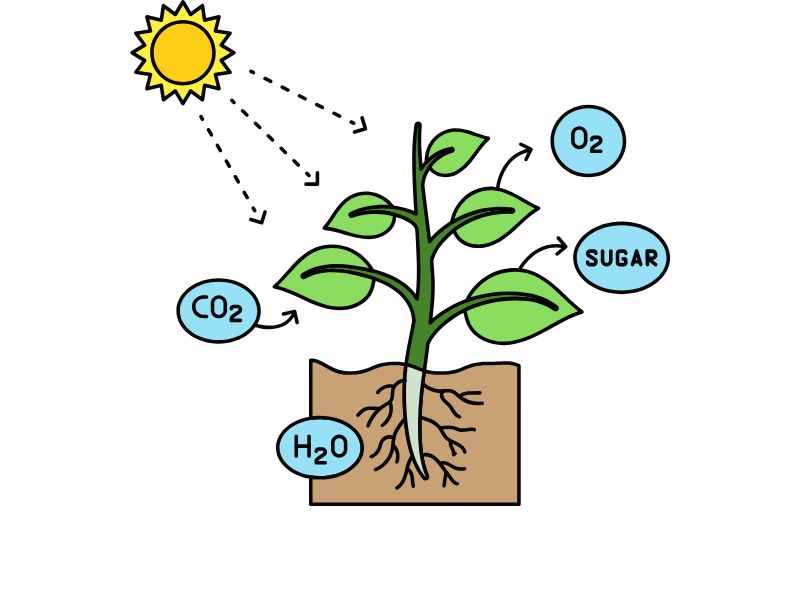
They rely on a natural process called photosynthesis (say: foe-toe-SIN-thuh-sis). It’s how they make food from sunlight, air, and water.
Here’s how it works:
- 🌬 Carbon dioxide from the air enters through tiny holes in leaves
- 💧 Water is absorbed by roots and pulled up through the stem
- ☀️ Sunlight is captured by chlorophyll, the green pigment in leaves
With these three ingredients, the plant builds a sugar called glucose, which it uses as fuel to grow.
And as a bonus?
It releases oxygen back into the air — the same oxygen we breathe!
So when you ask, “do plants eat sunlight?” the best answer is:
Not exactly. But they use sunlight to ‘cook up’ their own food.
What Does Soil Do Then?
If plants can make food with just air, water, and sunlight…
Why do they still need soil?
Soil doesn’t give them energy, but it provides essential nutrients like:
- Nitrogen – helps build proteins
- Phosphorus – supports root growth
- Magnesium – used to create chlorophyll
Without these, plants can’t build strong cells or carry out photosynthesis effectively.
Think of it like this:
Sunlight is the oven. Soil is the recipe box.
Plants need both to grow healthy and complete.
What’s Really Happening Inside the Leaf?
Photosynthesis is more than just mixing air and sunshine.
It’s a chemical reaction happening inside the leaf’s cells — specifically in parts called chloroplasts.
Inside each chloroplast, sunlight is used to rearrange atoms in water (H₂O) and carbon dioxide (CO₂). The result?
- C₆H₁₂O₆ (glucose) → plant food
- O₂ (oxygen) → fresh air for us
It’s like solar-powered chemistry.
No other living thing makes energy this way.
Why It Matters
Without photosynthesis, life on Earth… just wouldn’t work.
Understanding what photosynthesis is shows us just how deeply connected all life is. It explains how plants make food, why plants need sunlight to grow, and how sunlight and plant growth are linked — not just for plants, but for everything.
First of all, photosynthesis is the starting point of every food chain.
When a plant makes food from sunlight, that energy doesn’t just stay with the plant. It moves.
- A rabbit eats a leaf.
- A fox eats the rabbit.
- A mushroom breaks down the leaf when it falls to the ground.
But no matter what the food looks like — it all began with light and a leaf.
That’s why scientists say plants are producers — they make the energy that other organisms consume.
Without them, there would be no energy to pass along.
Second, photosynthesis gives us the air we breathe.
Each time a plant turns sunlight into sugar, it releases oxygen into the air as a byproduct.
- Forests act like giant green lungs
- Underwater plants keep rivers and oceans healthy
- Even your houseplants are quietly cleaning your air
So the next time you take a deep breath, remember — you can thank a plant!
Finally, photosynthesis helps keep the planet balanced.
Plants absorb carbon dioxide, which helps reduce greenhouse gases in the atmosphere. They literally cool the Earth, while feeding and supporting the animals and people who live on it.
All of this… from something that just stands in the sun.
Photosynthesis isn’t just how plants grow — it’s how life happens.
Still Wondering?
- What happens to photosynthesis when there’s no light?
- Do all plants photosynthesize the same way?
- Can photosynthesis happen underwater?
- Could we ever build solar panels that work like leaves?
Want More Curiosity-Filled Plant Science?
If this made you appreciate leaves a little more, you’ll love what else we explore.
From forests that talk underground to plants that trap bugs for lunch, our Quietly Clever blog makes nature’s weirdest questions simple (and seriously cool).